Interactive learning · AI systems
AI Demystified
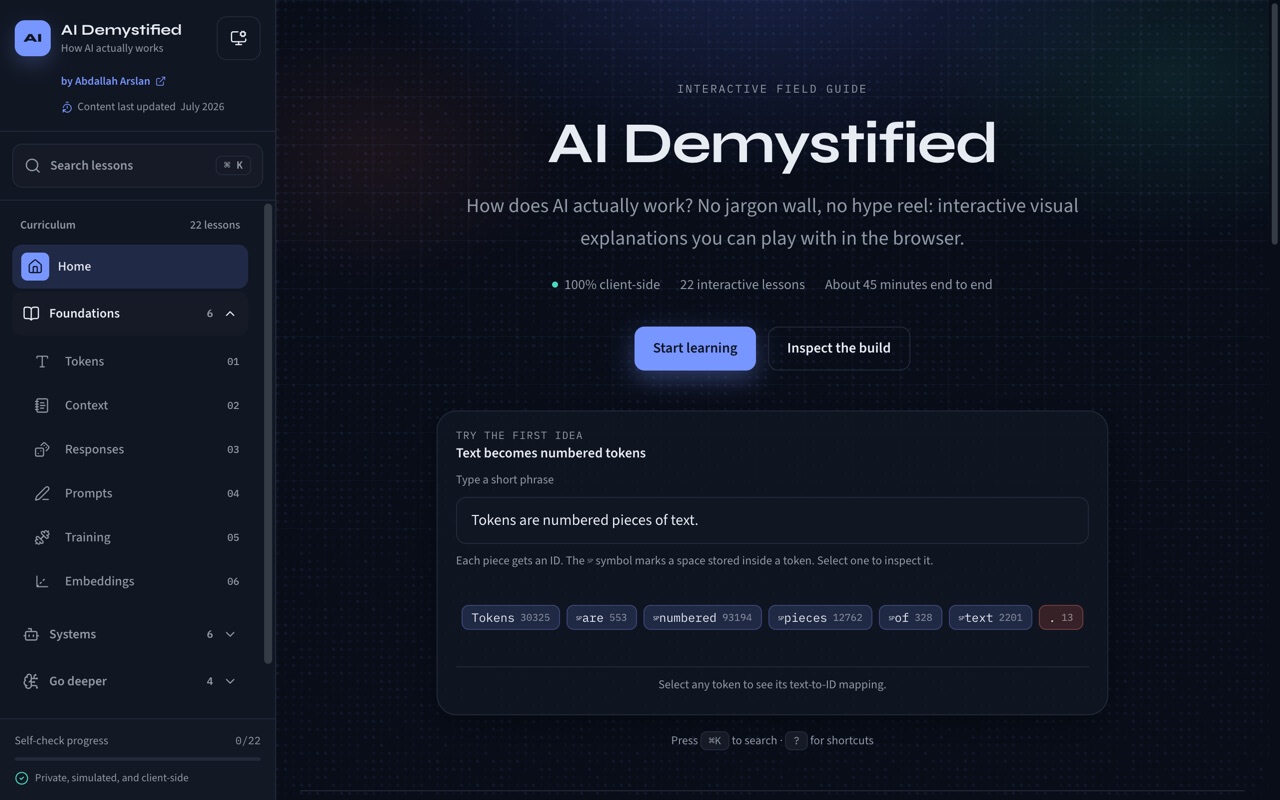
How AI actually works, in the browser
Turn AI concepts into small experiments with visible assumptions and inspectable sources.
- Source private
- Live
My role: Curriculum, interaction design, simulation code, evidence manifests, and delivery.
- Next.js
- TypeScript
- Client-side
- 22 lessons
At a glance
- Problem
- AI explainers split into marketing gloss and research papers, with nothing in between that a curious engineer can actually poke at.
- My contribution
- Curriculum, interaction design, simulation code, evidence manifests, and delivery: 22 lessons in Next.js and TypeScript, with the teaching simulations kept as pure modules behind the interface and factual claims held in typed evidence manifests with sources and review dates.
- Outcome
- Live and self-contained: lessons across foundations, systems, deep dives, and a capstone playground, verified by unit, numerical, accessibility, interaction, and mobile suites. The simulations illustrate mechanisms; they are not provider benchmarks.
Engineering decisions
01
Let the learner change the system
The agent lesson compares a fixed workflow and a bounded agent loop. Learners can change step and token budgets, introduce a staged timeout, and inspect recovery or the reason execution stops.
02
Separate a teaching model from a deployed model
The simulations run locally. Their traces illustrate mechanisms; they do not establish that a provider made the illustrated call or would produce the same answer.
Tradeoff
A local simulation is honest about being a model of a model, and it cannot show a live provider's actual latency, pricing, or answers.
03
Keep evidence beside the claim
Typed manifests record sources, scope notes, and review dates. Pure simulation modules make numerical and interaction behavior testable without relying on prose alone.
What you can verify
- Explore the 22-lesson curriculum and manipulate the agent experiment.
- Follow a lesson's sources and review scope.
- Use the lesson source panels to distinguish supported facts from teaching simulations.
Source and release links checked .
Scope and limits
A simplified simulation is a teaching device. Token counts, timings, and model behavior should be interpreted within the lesson's stated assumptions, not as a provider benchmark. The source repository is private; the live lessons expose their references and scope notes.
A short walkthrough
- 01
Open the agent lesson and run its fixed workflow and agent loop with the same scenario.
- 02
Introduce a simulated failure or reduce a budget, then pause and step through the state changes.
- 03
Explain the stopping condition and compare the teaching model with the lesson's sources.