Scientific tools · worked calculations
Quemist
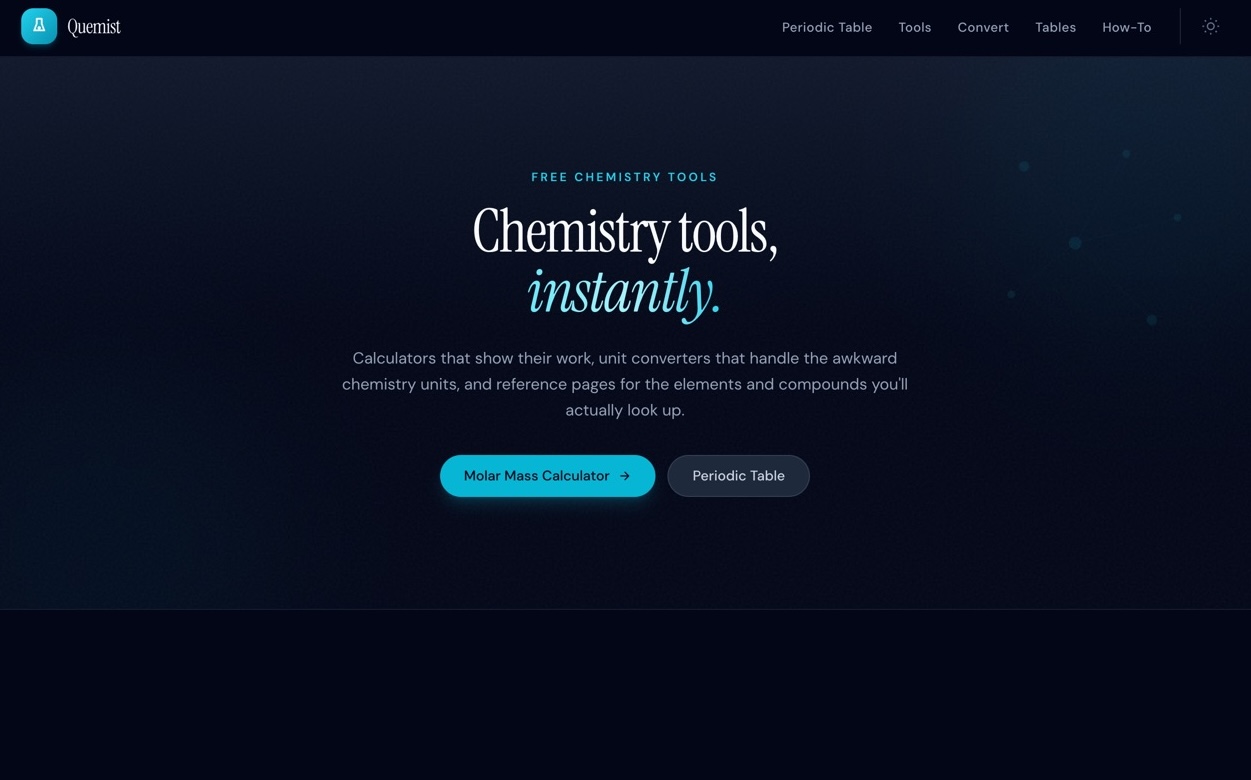
Chemistry tools, instantly
Make chemistry arithmetic inspectable through visible steps, units, and reference material.
- Source private
- Live
My role: Product design, calculators, reference presentation, and operation.
- Live product
- Client-side
- Worked calculations
At a glance
- Problem
- Students need chemistry tools that show their arithmetic and units without requiring an account.
- My contribution
- Product design, calculators, reference presentation, and operation: fully client-side calculation with SEO-structured reference content and complete legal and accessibility pages. The free site is supported by advertising.
- Outcome
- A live product I operate end to end: calculators that show every step, unit converters, and an interactive periodic table covering all 118 elements.
Engineering decisions
01
Show the arithmetic
One connected workflow carries a formula through molar mass, solute mass, moles, final solution volume, and molarity. An optional stronger stock concentration adds a C₁V₁ = C₂V₂ dilution calculation.
02
Keep calculations in the browser
Interactive calculators and converters respond locally and require no account. URL-based inputs make supported calculations shareable.
Tradeoff
No accounts means no saved history; a calculation is shared by its URL or printed worksheet instead.
03
Make assumptions part of the answer
Worked steps retain units and small values instead of rounding them to zero. The worksheet states its complete-dissolution, purity, and volume assumptions, and distinguishes formal concentration from individual ion concentrations.
What you can verify
- Live calculators, unit converters, and a periodic table covering 118 elements.
- A worked NaCl preparation connects the element breakdown to concentration and optional dilution.
- Share the inputs by URL or print a worksheet with the calculation and assumptions.
Source and release links checked .
Scope and limits
Educational calculations depend on the calculator's assumptions and reference values. The site is free and supported by advertising; it is not a validated laboratory or clinical decision system.
A short walkthrough
- 01
Enter NaCl, a solute mass of 5.844 g, and a final solution volume of 250 mL.
- 02
Check the 0.100000 mol and 0.400000 mol/L result, then enter a 1 mol/L stock concentration.
- 03
Inspect the 100 mL stock calculation and share or print the worked steps with their assumptions.